Frequently Asked Questions
-
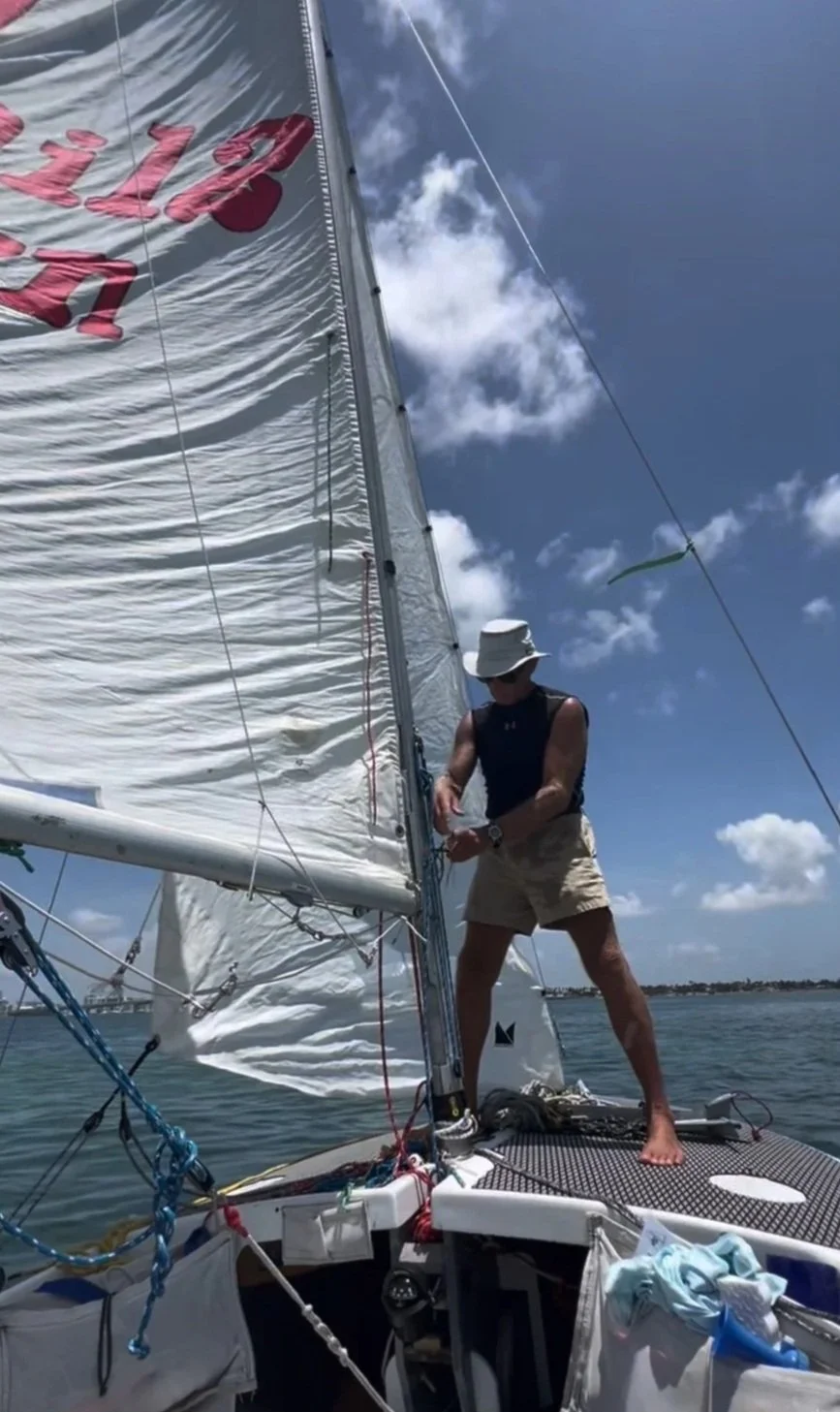
Sailboats can travel in almost any direction except directly into the wind. The area about 45° on either side of the wind direction is called the No Sail Zone—if a boat points into it, the sails will flap and the boat will slow or drift backward.
To move toward a destination that lies upwind, sailors use a technique called tacking. By sailing back and forth across the wind at an angle, the boat makes steady progress upwind. Each change of direction is a tack, and a series of tacks allows the boat to reach places it can’t sail to in a straight line.
-
Before your first lesson, we’ll meet for a brief orientation to discuss your experience, set goals, and review safety basics.
On lesson day, please bring:
Lesson fee (cash preferred, but Zelle and PayPal are options too)
Sunscreen (non-oily)
Sunglasses with a retaining strap
Water shoes (for shells and shallow-water hazards)
Hat or cap
Towel and a change of clothes (leave in your car)
A PFD (personal flotation device), if you have one—let us know your size if not
Bathing suit with shorts and a T-shirt
Light jacket if the weather is cool
Refillable water bottle
Ice and a cooler are provided. Lessons are typically scheduled in warm weather (above 60°F), Florida-style.
-
For safety and focus, please do not bring:
Tanning oils or slippery lotions
Cell phones, cameras, or music players (leave them in your car)
Tobacco products, including smokeless tobacco
Alcoholic beverages
We want everyone fully engaged and safe on the water—celebratory drinks can wait until after the lesson.
-
The launch location is discussed during your orientation. For first lessons, we typically launch at the Ken Thompson Park boat ramps on City Island. We’ll rig and load the boat in the parking lot, then launch from the ramp. The exact location will be confirmed by phone a few hours before your lesson.
-
Yes. Students should be able to tread water for 10–15 minutes, or be comfortable staying afloat in a PFD (Personal Flotation Device or buoyancy aid) for that amount of time. PFDs are carried on board in accordance with U.S. Coast Guard regulations and will be worn when conditions require.
Because small sailboats can capsize, students must be comfortable with the possibility of getting wet and swimming briefly. In the event of a capsize (very difficult to do in a Flying Scot), it’s important to stay with the boat and maintain a handhold. Any planned capsize practice is done in shallow water and calm conditions for safety.
-
It sounds dramatic, but a capsize is usually no big deal—especially in fair weather. During lessons, if requested - we practice capsizing and recovering the boat in shallow water so you can learn the process calmly and confidently. After a few tries, most students can get the boat upright again in under 90 seconds.
Once you’ve got the hang of it, it often turns into one of the most fun parts of the lesson—and for many students, a favorite memory of the day! The Flying Scot WILL NOT sink. It has huge underseat sections of styrofoam - AND a large air bladder in the bow. We may have to bail 4-6” of water after a capsize but no worries about sinking.
-
No matey!—no sailor-babble overload here! We introduce sailing terms naturally as we go, and you’ll start using them right away on the water. By the end of your lesson, you’ll know the difference between a sheet (rope) and a sail, port and starboard, keel and rudder, tacking and gybing, and much more.
You’ll learn the language by doing, not memorizing. And if you’d like a head start, you can check out our learning materials section to learn sailboat parts and their functions before your lesson.
-
Yes! A fantastic place to start is Sailing for Dummies by JJ and Peter Isler—both highly accomplished (Olympic & America’s Cup) sailors. Don’t let the title fool you; it’s a well-written, thorough, and very approachable guide to sailing. It covers a wide range of topics, from day sailing and cruising to racing and more.
The book is easy to read, full of helpful illustrations, and even a little humorous, making it enjoyable as well as informative. If you like to prepare ahead of time, it’s a great resource to have.
Another fantastic sailing book you’ll truly cherish is First You Have to Row a Little Boat: Reflections on Life and Living by Richard Bode. I find my own sailing experiences closely mirror Richard’s insights. Learning to sail reveals countless valuable life lessons, each one vividly brought to life on the water.
-
On a small sailboat, you’ll occasionally need to pull yourself back in after a capsize or a fall overboard—no worries, JoySea Too has a swim ladder on the stern to make it easy. If you’re aiming for speed, you’ll also practice hiking out—leaning over the side of the boat as it heels in stronger winds. This uses your core and hip muscles, but don’t worry: if you can do twenty deep lunges, twenty sit-ups and ten push-ups, you’ll be in great shape to enjoy sailing!
However - reality check! The Flying Scot cockpit is large - but has a boom above it at head height (while sitting), and an 18” tall centerboard trunk on the centerline dividing the cockpit. During hands-on drills students will rotate to crew positions clockwise and therefore be required to step over the centerboard trunk WHILE ducking below the boom (and boom vang)! If you’ve recently had a knee or hip replacement (or similar) it would be best to wait for full recovery!
-
Absolutely not! You don’t need a pocketful of merit badges to enjoy sailing. In fact, there are only about six essential knots (plus a few variations) that are truly useful—critical if you don’t want your boat drifting off after you “secure” her.
Most of these knots are easy to learn, and once you know them, you’ll handle lines like a pro—no scouting resume required. Check out our learning materials page to start getting familiar!
-
Not on JoySEA Too—she’s a true daysailer, so no onboard “head.” But don’t worry! There are plenty of bathrooms nearby:
Launch sites: Ken Thompson, Centennial Park (10th St)
Beach parks: City Island, Centennial Park, New College Waterfront/Sailing Club, South Lido, Lido Beach, Ted Sperling Park
Restaurants: New Pass Grill, Dry Dock, and O’Leary’s.
We’re usually within 10–15 minutes of a restroom.
-
Absolutely not—we respect Mother Nature! We set a target date and time (sometimes a range) for each outing, but if the forecast calls for lightning, thunder, strong or erratic winds, or other unsafe conditions, we’ll stay onshore.
For beginner classes, we look for sunny or partly cloudy skies, steady winds of 5–15 MPH, and flat water—10 MPH is ideal.
If a surprise squall appears while we’re on the water, we’ll beach JoySEA Too and wait safely until it passes. Safety always comes first!
-
For children, it really depends. Sailing can be exciting, but a capsize might be frightening—and long stretches on the water can be boring for some kids. Ask yourself: Are they genuinely interested in learning to sail? Can they stay attentive for the duration of the trip?
As for pets… as much as we love them, it’s a no-go during lessons. My previous dog, Carter, and current girl - Gal, love to join me on non-lesson sails—but they sometimes jump overboard if nature calls or they spot a dolphin or cormorant fishing! Fun for them, serious distraction for students, AND pets can overheat easily. For safety and focus, it’s best to leave furry friends on shore.
-
No worries—these things happen! Just give me a call as soon as possible at 912-481-0718, and we’ll do our best to reschedule your sailing adventure.
